The first time I met Richard was a moment not soon to be forgotten. Sprinting across the orphanage yard I feared what I was about to encounter as I approached my target: mischievous orphans at the moment obviously up to no good. Through my building anger and limited Spanish, a reoccurring reality at the orphanage was made clear to me yet again: there are just some moments you face where no amount of strength can prepare you for what you can´t believe you are witnessing.
On that day, it was the image of a severely mentally retarded child drowning if you can imagine it in the dirt he was being physically held down in, trying to cry but unable to because of the sheer amount of dirt that caked his face, covered his eyes, and had been shoved along with various pieces of trash into his mouth. In between the frantic movements and the spurts that could only be a failed attempt to cry, I struggled to see the humanity in the children that could do this.
After a moment of shock I disbanded the group of older, ¨more mentally competent" children that did this and picked up this child and took him inside to clean him up. I silently cursed the little brats who treatened to make my tears a routine part of visiting the orphanage, and at the same time, thanked God for delivering this retarded orphan who could easily be described as the most unloved of an already unwanted group into my direct attention.
Rest assured the next chapter of this ever unfolding story is actually a happy one.
Father Engh some weeks back suggested to be less preoccupied with the words that we speak or do not speak, and instead try and focus on the incredible ability in our human capacity to communicate and receive communication in spite of the language barrier that we at times suffocate ourselves with.
And that brings us to Richard. A good part of my time at the orphanage today was spent with Richard in my arms, running around to the other kids and telling them: ¨Quiero presentar mi mejor amigo... Entonces, chicos y chicas, por favor miran a Richard, el rey del mundo.¨ Translation: I want to present my best friend so boys and girls, please look at Richard, the king of the world! (at least that is what I hope I was saying...)I said that little speech over and over, every time with a bit more enthusiasm and excitment as for the first time little Richard through his giggles and smiles, actively was responding to what I was doing.
When I finally said goodbye for the day, a little retarded boy they always told me could not talk spoke volumes as he responded to my words of goodbye with the loudest of cries and struggling, he stumbled toward me with outstretched arms, and as I crouched down to look into his usually nonresponsive eyes, he starred intently back at me for a brief moment before wrapping his little arms around my neck, drawing himself closer to me, and giving me a kiss on the cheek.
Richard, the mentally retarded child has never once spoken a word to me. But today, he communicated something I never would have thought he had the ability to, if only because it is a task I have not been able to do myself: Today, Richard gave me back a bit of the self-worth and dignity I have felt void of, and while he might not be able to teach me the Spanish I am convinced will give me that self worth (imagine having the advanced thought process of a 23 year old adult but only being able to speak like a 5 year old child and you might get a feel for why self worth is such a rarity these days), he overcame his own severe handicaps to allow me to see his own humble but valuable gifts, and in return allow me to see in a way I have struggled at times to see: I am not only called to South America, but in the smallest and most humble of ways, in spite of my own handicaps and limitations, perhaps needed as well. I might change the systematic poverty that defines much of this continent, but maybe I can change one life, one day at a time, and in turn, be open to the change that occurs within me as well.
“All…are caught in an inescapable network of mutuality, tied in a single garment of destiny. I can never be what I ought to be until you are what you ought to be, and you can never be what you ought to be until I am what I ought to be. This is the interrelated structure of reality.” –Martin Luther King, Jr.
Tuesday, October 31, 2006


Wednesday, October 25, 2006
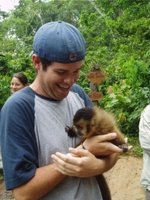
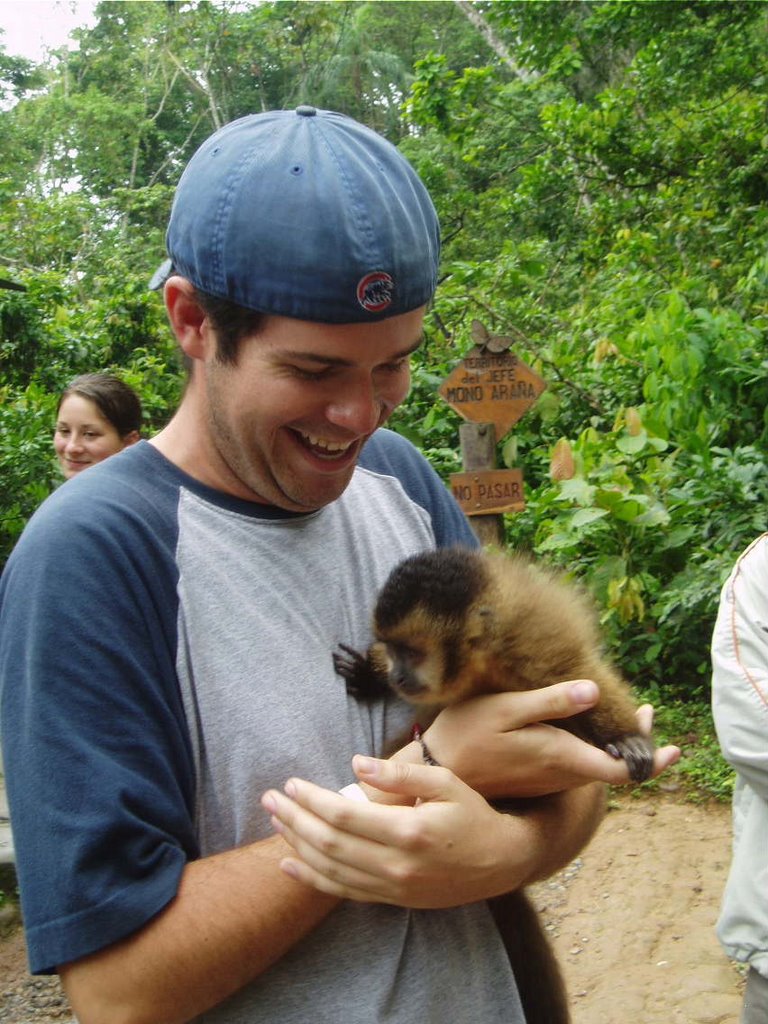
Ever had a monkey run and jump on you? Only in Bolivia
I wonder how awake he really is... I sat in the back of this van, busy watching the eyes of the driver in the mirror. Were they tired, was he perhaps drunk last night and since we agreed to meet to start the trip at 4 AM, maybe he was still drunk? These were the thoughts I had. I had a flash back to being 15 again and at that lesson in drivers education where they taught us to never cross a double yellow, and more so, never pass another vehicle by entering on coming traffic on a blind curve. As I nervously gripped the seat in front of me, I wondered why they did not teach the same basic lesson in Bolivia. Life is a game of calculated risks, and the math just seems so much more fuzzy in this crazy country. And this day, beginning at 3:45 AM, would be no different.
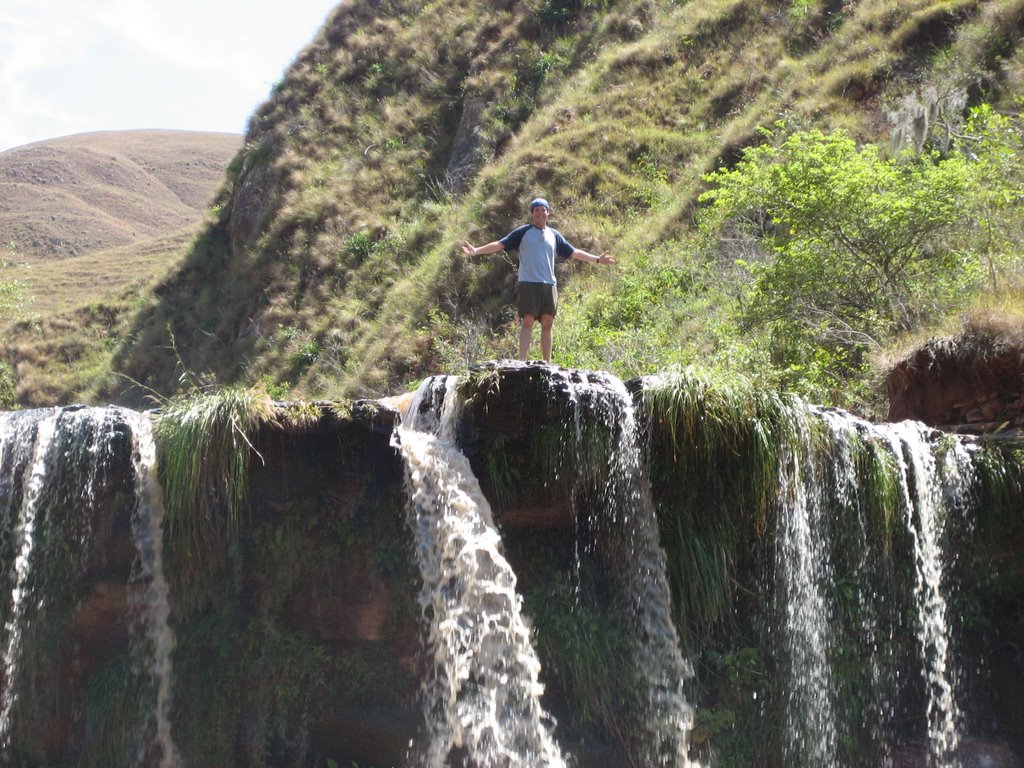
After hours in a crowded van with a driver who seemed to accelerate more when it rained and when we were on unpaved roads, we at last reached our destination, THE JUNGLE! And so this is a glimpse of my crazy weekend in the jungles of Bolivia...
I played with monkeys eager for human attention, and sneaky enough to steal anything in your pockets and disappear into the wilderness once again. I thought the monkeys were crazy until I found myself looking through thick jungle and just 10 feet away making eye contact with a full grown Puma. The leash its master held it on was comforting, a fence would have been a little more comforting, but amenities such as those are hard to come across.
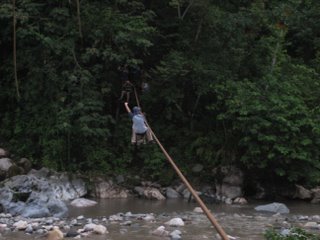
If monkeys and pumas were not enough, I went into the heart of the jungle, via a rope line over a river to view mysterious plants, big insects, and walk into the heart of caves full of bats excitedly flying all around your head, paralyzing your mind.

I tried to visit an Orchid farm, and it being closed, took the advice of our tour guide to just trespassed and spend some time looking at leaves the size of half my body, beautiful flowers, and oh yeah, crocodiles, because that is all part of the experience.
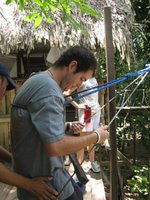
That would have been enough for me but apparently no trip to the jungle is complete without a trip to their amusement park, the Jungle (creative title, no?). This jungle was great, after you got over the fear that the slim piece of wood they called a seat and the rope that went over your shoulder they called a seat belt was anything but secure. All that needs to be said is love me or not, you might want to start paying the small fee for life insurance in my name, it might one day yield great results... Just kiddin, kinda. Something about jumping off a platform, held only by rotting wood, tethered rope, and an old tree branch both frightens and amuses. I was about to do the tallest of the jumps until I saw it go not to well for a friend, and mom you will be proud, it was the first time where my common sense (this is not how I picture my life ending) won out over my ego.
Maybe the life insurance won´t be needed after all, and while some of this might frighten some of you (hi mom) rest assured, I am having the time of my life in the jungle that is metaphorically and physically, Bolivia.
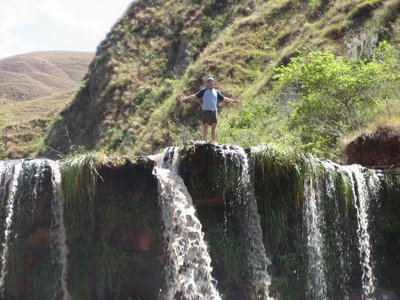
After hours in a crowded van with a driver who seemed to accelerate more when it rained and when we were on unpaved roads, we at last reached our destination, THE JUNGLE! And so this is a glimpse of my crazy weekend in the jungles of Bolivia...
I played with monkeys eager for human attention, and sneaky enough to steal anything in your pockets and disappear into the wilderness once again. I thought the monkeys were crazy until I found myself looking through thick jungle and just 10 feet away making eye contact with a full grown Puma. The leash its master held it on was comforting, a fence would have been a little more comforting, but amenities such as those are hard to come across.
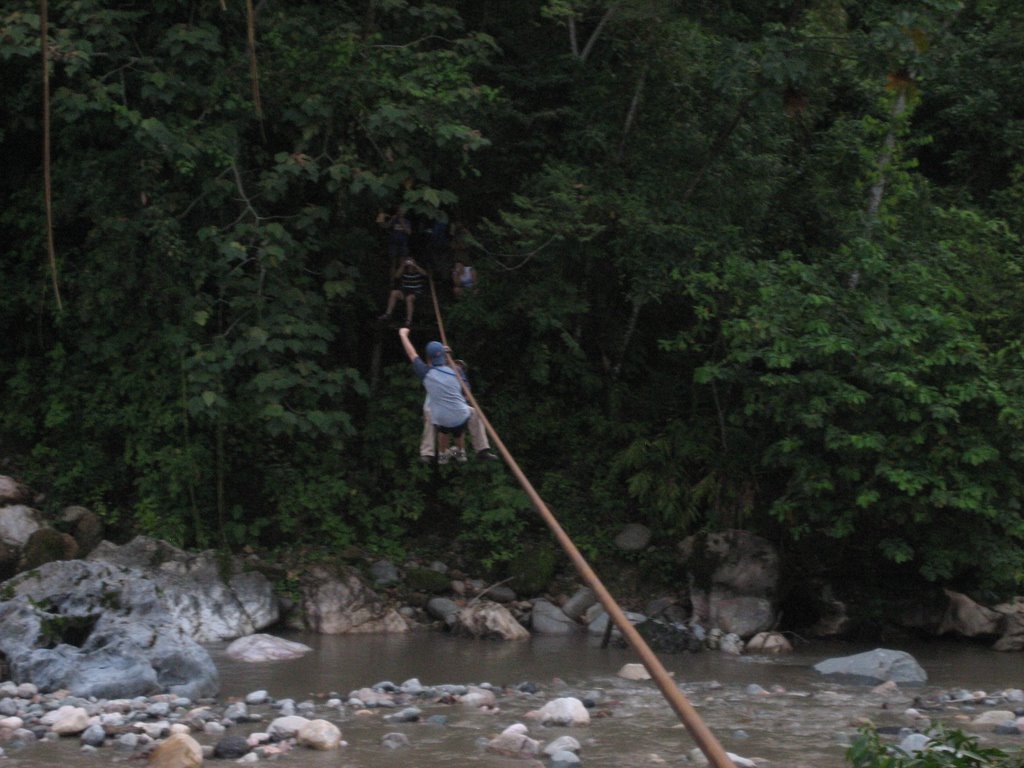
If monkeys and pumas were not enough, I went into the heart of the jungle, via a rope line over a river to view mysterious plants, big insects, and walk into the heart of caves full of bats excitedly flying all around your head, paralyzing your mind.

I tried to visit an Orchid farm, and it being closed, took the advice of our tour guide to just trespassed and spend some time looking at leaves the size of half my body, beautiful flowers, and oh yeah, crocodiles, because that is all part of the experience.

That would have been enough for me but apparently no trip to the jungle is complete without a trip to their amusement park, the Jungle (creative title, no?). This jungle was great, after you got over the fear that the slim piece of wood they called a seat and the rope that went over your shoulder they called a seat belt was anything but secure. All that needs to be said is love me or not, you might want to start paying the small fee for life insurance in my name, it might one day yield great results... Just kiddin, kinda. Something about jumping off a platform, held only by rotting wood, tethered rope, and an old tree branch both frightens and amuses. I was about to do the tallest of the jumps until I saw it go not to well for a friend, and mom you will be proud, it was the first time where my common sense (this is not how I picture my life ending) won out over my ego.
Maybe the life insurance won´t be needed after all, and while some of this might frighten some of you (hi mom) rest assured, I am having the time of my life in the jungle that is metaphorically and physically, Bolivia.
Tuesday, October 17, 2006
Meeting my Great-Grandfather In Bolivia
I saw my great-grandfather today. Walking to school like any other day, but suddenly I noticed him. There he was, sitting in a ditch just outside the gates of the language school. He sat alone and he looked tired. His face was dirty, and his eyes looked lifeless, sadly, even hopeless. But in his face I could clearly see the man who chanced and sacrificed so much for me, never knowing what his efforts would produce. But here we were, me looking at him, clearly seeing a man who escaped the vicious poverty of Ireland that left him little options but to escape to a supposed better life, to become an alien in the land of opportunity. So here I stood, looking at a living face of history: college degree securely behind me, the world optimistically ahead of me. I looked into these curious eyes which looked silently back at me. How would I respond?
I had so much to say to this man, so much built up but as I looked into his brown Bolivian face words were a luxury neither of us would have that day. In the refuge of our shared silence, I could only hope that somehow he knew what was racing through my mind, what I so badly wanted to tell him but at that time, had no ability, perhaps even no right to say.
If I could look into this native and dark Bolivian face and out of it pull the image of my own family, I hoped he could look back at my pale gringo face and somehow in me, see his own kin. I wanted him to know that the poverty which pretty much was assigned to him at birth because of the location of the world he was born into angered me just as much as when I thought about the wretched poverty so many in my family endured in Ireland. I imagined what it would be like if years from now, my path and his were to cross again, but this time in Chicago or Los Angeles, where he had perhaps attempted to escape a life of poverty to claim what was his right as much as anyone else’s: a chance to feed his children and give them an opportunity at a life other than vicious and dedegradingoverty. And so I imagined seeing him in LA, working some difficult dead end job for little pay and no benefits, and I wanted to let him know that illegal would not be the word I would disdainfully use to describe him. For was not my own great-grandfather an alien in a country that promised opportunity, a treasure in his time he perhaps discovered somewhere behind the many signs and want ads that read ¨Jobs available: Blacks and Irish NEED NOT APPLY! ¨
I do not know the real face of the man I would call my great-grandfather. I know he lived in an impoverished land, escaped it and fled to America in pursuit of something more and for that, faced severe discrimination. He endured so much, even his own child, my grandfather, endured so much for me, and sadly, I do not know what they looked like. But all that got me thinking, imagine if we were able to look at the real human face of poverty and ¨illegal¨ immigration, and political rhetoric aside, we were able to see in that once foreign face our own family who at some time or another struggled against the odds and discrimination to get us where we are today.
I saw my great-grandfather in the face of an impoverished Bolivian today, and against the odds of our cruel and spiteful world, I hope in my face and my experience, he was able to get a glimpse of his own kin. Only when we identify with that face and see our common good linked to theirs will we begin to understand it is the poverty that should be illegal, not the person.
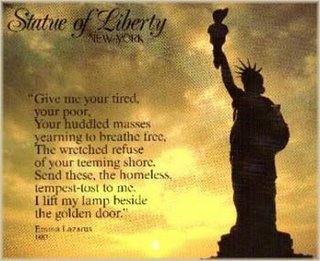
When my great grandfater came to America, he was greeted by these words on the Statue of Liberty..."Give me your tired, your poor, Your huddled masses yearning to breathe free, The wretched refuse of your teeming shore. Send these, the homeless, tempest-tost to me, I lift my lamp beside the golden door"
I wonder if we will put the same words on that gigantic wall we want to build across the Mexican border?

I had so much to say to this man, so much built up but as I looked into his brown Bolivian face words were a luxury neither of us would have that day. In the refuge of our shared silence, I could only hope that somehow he knew what was racing through my mind, what I so badly wanted to tell him but at that time, had no ability, perhaps even no right to say.
If I could look into this native and dark Bolivian face and out of it pull the image of my own family, I hoped he could look back at my pale gringo face and somehow in me, see his own kin. I wanted him to know that the poverty which pretty much was assigned to him at birth because of the location of the world he was born into angered me just as much as when I thought about the wretched poverty so many in my family endured in Ireland. I imagined what it would be like if years from now, my path and his were to cross again, but this time in Chicago or Los Angeles, where he had perhaps attempted to escape a life of poverty to claim what was his right as much as anyone else’s: a chance to feed his children and give them an opportunity at a life other than vicious and dedegradingoverty. And so I imagined seeing him in LA, working some difficult dead end job for little pay and no benefits, and I wanted to let him know that illegal would not be the word I would disdainfully use to describe him. For was not my own great-grandfather an alien in a country that promised opportunity, a treasure in his time he perhaps discovered somewhere behind the many signs and want ads that read ¨Jobs available: Blacks and Irish NEED NOT APPLY! ¨
I do not know the real face of the man I would call my great-grandfather. I know he lived in an impoverished land, escaped it and fled to America in pursuit of something more and for that, faced severe discrimination. He endured so much, even his own child, my grandfather, endured so much for me, and sadly, I do not know what they looked like. But all that got me thinking, imagine if we were able to look at the real human face of poverty and ¨illegal¨ immigration, and political rhetoric aside, we were able to see in that once foreign face our own family who at some time or another struggled against the odds and discrimination to get us where we are today.
I saw my great-grandfather in the face of an impoverished Bolivian today, and against the odds of our cruel and spiteful world, I hope in my face and my experience, he was able to get a glimpse of his own kin. Only when we identify with that face and see our common good linked to theirs will we begin to understand it is the poverty that should be illegal, not the person.
When my great grandfater came to America, he was greeted by these words on the Statue of Liberty..."Give me your tired, your poor, Your huddled masses yearning to breathe free, The wretched refuse of your teeming shore. Send these, the homeless, tempest-tost to me, I lift my lamp beside the golden door"
I wonder if we will put the same words on that gigantic wall we want to build across the Mexican border?


Tuesday, October 10, 2006
Fighting Explotation- One Arrest at a Time
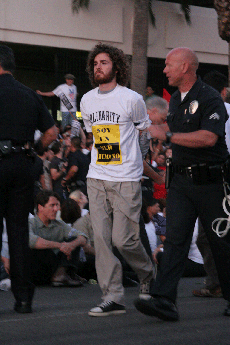
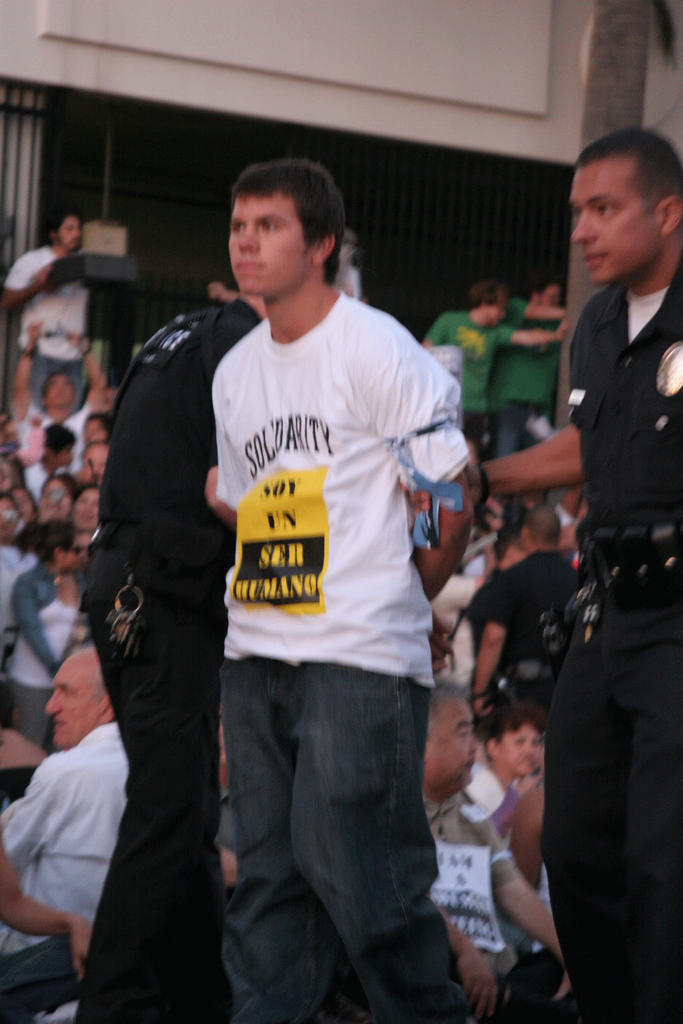
About a week ago a group of students from my former university, Loyola Marymount, joined a couple thousand other people in the busy hotel district next to the international airport to demand dignity and rights for the employees that worked in those buildings. Any more these days, the news I get from the United States is more depressing than inspiring. Perverted congressman and the equally perverted people who protected him. The announcement that the United States plans to build a wall all the way across our country to keep out immigrants, immigrants that want a better life and in turn add to the quality of life in our country. And so, it was with great joy that I came across an article in the LA Times about the protest for human rights and dignity, and in that article, came across a photo of a good friend, Charles Bergman, who joined a sit in on Century Blvd. and for his decisions, was arrested, along with 11 other students.
And so, I read these students explanations as printed in the Los Angeles Loyolan and was incredibly moved and touched. And so, I feel the words expressed by these students are so powerful I want to share them with all of you today, as our country is locked into a debate about immigration. To all of my friends who sat peacefully in the street and spent the night in jail, I am proud and honored to call you friends.
And now, onto their words...
We -- the twelve LMU students and one LMU professor arrested for civil disobedience on Sept. 28 -- are grateful to the Loyolan for their prominent coverage of our efforts on behalf of the Century Blvd. hotel workers. We also applaud the staff for their decision to use the board editorial to voice support for our actions.
Thanks as well to Jeremy Tratner and Brendan Busse, who demonstrated their commitment to this struggle with both their presence and their words in the Oct. 2 issue. In fact, the entire process that led us to spend a night in jail would not have been nearly as powerful if it had not occurred within a community such as LMU, where compassionate engagement with the wider world is prized as an essential component of our mission.
With that said, we would like to add to the conversation with some clarifications. First of all, the front-page news article by Katie Slack that ran last Monday, though admirable in most respects, did a disservice to the event by focusing so heavily on the "counter-protest" by Minutemen volunteers. It should be pointed out that this contingent was miniscule: from our first-hand view, it numbered about a dozen people, compared to over a thousand supporters.
Furthermore, the Minutemen's relentless focus upon the possible "illegality" of some workers ignores the complexity of the issues at hand. We marched and went to jail for the rights of immigrants, certainly. But we also took this action to demand recognition of the basic rights of workers to a safe workplace and a living wage, and to promote the health of families in the Angeleno community of which LMU is a part.
Above all, we were arrested in order to assert our collective opposition to the assumption that it is perfectly acceptable to exploit anyone, at any time and for any reason if it makes you or your company more profitable. It makes a mockery of human dignity to suggest that justice ends at a border fence.
Secondly, asserting again our gratitude for the Loyolan's support, we wish to add some nuance to the portion of their editorial that lumps SLEJ in with "other philanthropic groups." Philanthropy is a noble endeavor and a dire necessity in the non-profit sector, but it is not the intent of either SLEJ or other like-minded organizations (such as Underwings, Magis, Sursum Corda and MEChA, all of which channeled enthusiasm into the protest) to simply contribute money to a good cause.
As Martin Luther King, Jr. says, "Philanthropy is commendable, but it must not cause the philanthropist to overlook the circumstances of economic injustice which make philanthropy necessary." We were motivated to embark on the dramatic act of civil disobedience precisely because the situation on Century Blvd. reveals the structural sinfulness of a situation in which human beings are continually degraded. Xenophobia, racism and fundamental inequalities are not addressed by merely throwing money at the problem -- though we would certainly love to see the airport hotels cough up more money to their employees.
Philanthropy may also, if not pursued in a conscientious manner, bypass the transformational opportunity available in openhearted encounter with the poor and oppressed. Each of us among the arrestees had been prompted to pursue this path at least in part because of our prior experiences of meeting the poor face-to-face and on their own terms.
While we consider ourselves allies of anyone who contributes time, energy or money to tackle the many ills of this world, we believe that our greatest hope resides in our willingness to enter honestly into the suffering endured by the vast majority of our fellow humans. When we are transformed by that encounter, we may then begin to genuinely seek transformation of unjust social structures.
Thank you again to the Loyolan and the entire LMU community for not only their support of our actions, but more importantly, for their support of our sisters and brothers who labor within our very own backyard. It is their story that we hope to bring to light and their struggle with which we stand in solidarity.
This editorial is meant to express the collective opinion of the twelve LMU students and one LMU professor who participated in the act of civil disobedience on Century Blvd. on Sept. 28.
Marian Alonso, Psychology/Music '08
Charles Bergman, Film Production/Theological Studies '07
Erika Cuellar, Liberal Studies/Spanish '08
Richard Espinoza, Assistant Professor of Chicana/o Studies
Andy Etchart, Business '09
Anthony Garcia, English '08
Colin Gilbert, Theological Studies/Spanish '07
Michael Gutierrez, Chicana/o Studies '09
Nicole Gutierrez, Sociology '08
Amanda Johnstone, History/Spanish '07
Sandra Nuñez, Psychology/Chicana/o Studies '07
Melissa Salter, English/Education '08
Nathalie Sanchez, Studio Arts/Art History '07
Tuesday, October 03, 2006
Cry Without Weeping
I have written about the fun times, the crazy times, and even the hope and inspiration I have found here. But I have written little on the absolute and real poverty that you come in contact with, day in and day out.
This last month could best be described as a time where many times, I am crying without weeping. At last, I wept. I visited an orphanage close to my house for the first time that day. This is my journal entry from that experience.
160 kids, a handful of exhausted employees. Papa, mira aqui. Por favor papa. There are no words that could ever explain the emotions that run through your veins, when, despite your limited Spanish, you understand quite well that these orphans are calling you dad as they cling onto you, thirsty for attention, and even more, hungry for you to take them home. You want to cry on the spot, but you can´t, because you are here to somehow help. So the games go on, the smile more difficult, and the questions more persistent ¨please dad, take me home with you.¨
An hour later I found myself in a room with 30 babies, and 3 employees. A baby cries from the floor, in front of my feet, as I bend down to pick her up, precious little eyes look into mine, and at the slightest touch, the crying ceases. Others around her begin crying, and as I move to pick up the next, the one I was just holding lets out an incredible scream of anguish. And so I stand in the middle of this ¨nursery¨, looking at the babies, dirt and helpless, innocent and yet, in some ways, already ruined, and am forced to make an agonizing decision. Who do you pick up and help, and who do you leave on the floor, screaming and wailing for attention? I have seen some pretty bad realities and yet, nothing will ever prepare a person for the first time they are forced into that decision. And so I reach for the child lying on the floor nearest to my feet, and as he stops crying, I finally begin. There is no build up to this moment, just a flood of emotions that comes crashing through all the defenses I have built up over the month, a sudden, honest, vulnerable release of emotion.
I go home after my time volunteering and at dinner, find myself feeling lonely just by the loneliness I witnessed. At dinner with the whole extended family present, my host sister asks me why I am sad. I am preoccupied studying the face of my host niece, a girl who looks just like another girl I played with in the orphanage. One girl showered with abundant love, the other, void of any. I look up at my sister and I know the expression on my face said that I wanted to tell them everything. But instead of a flow of words, a flow of tears and a voice desperate to scream out, but trapped within by my limitations. I want to tell these people everything, but sadly, I don´t have the language capabilities to express emotion yet, and so I can say nothing, only cry unashamedly before running out the door and into even more lonely streets of impoverishment.
This was my toughest day in Bolivia. Make no mistake, I am happy here. Uninvited, but truly called I believe. But day by day, poco a poco, I expect to find more answers and instead am confronted only with questions and more questions. And so, I don´t know. I have no brilliant insights to share with you today, only incredible frustration, which in the end, is really nothing more than incredible sadness, incredible pain. I came across a quote that said ¨glass shines better when its broken.¨ Metaphorically it sounds great, realistically, I can only hope its true for those kids, and day by day, for myself.
This last month could best be described as a time where many times, I am crying without weeping. At last, I wept. I visited an orphanage close to my house for the first time that day. This is my journal entry from that experience.
160 kids, a handful of exhausted employees. Papa, mira aqui. Por favor papa. There are no words that could ever explain the emotions that run through your veins, when, despite your limited Spanish, you understand quite well that these orphans are calling you dad as they cling onto you, thirsty for attention, and even more, hungry for you to take them home. You want to cry on the spot, but you can´t, because you are here to somehow help. So the games go on, the smile more difficult, and the questions more persistent ¨please dad, take me home with you.¨
An hour later I found myself in a room with 30 babies, and 3 employees. A baby cries from the floor, in front of my feet, as I bend down to pick her up, precious little eyes look into mine, and at the slightest touch, the crying ceases. Others around her begin crying, and as I move to pick up the next, the one I was just holding lets out an incredible scream of anguish. And so I stand in the middle of this ¨nursery¨, looking at the babies, dirt and helpless, innocent and yet, in some ways, already ruined, and am forced to make an agonizing decision. Who do you pick up and help, and who do you leave on the floor, screaming and wailing for attention? I have seen some pretty bad realities and yet, nothing will ever prepare a person for the first time they are forced into that decision. And so I reach for the child lying on the floor nearest to my feet, and as he stops crying, I finally begin. There is no build up to this moment, just a flood of emotions that comes crashing through all the defenses I have built up over the month, a sudden, honest, vulnerable release of emotion.
I go home after my time volunteering and at dinner, find myself feeling lonely just by the loneliness I witnessed. At dinner with the whole extended family present, my host sister asks me why I am sad. I am preoccupied studying the face of my host niece, a girl who looks just like another girl I played with in the orphanage. One girl showered with abundant love, the other, void of any. I look up at my sister and I know the expression on my face said that I wanted to tell them everything. But instead of a flow of words, a flow of tears and a voice desperate to scream out, but trapped within by my limitations. I want to tell these people everything, but sadly, I don´t have the language capabilities to express emotion yet, and so I can say nothing, only cry unashamedly before running out the door and into even more lonely streets of impoverishment.
This was my toughest day in Bolivia. Make no mistake, I am happy here. Uninvited, but truly called I believe. But day by day, poco a poco, I expect to find more answers and instead am confronted only with questions and more questions. And so, I don´t know. I have no brilliant insights to share with you today, only incredible frustration, which in the end, is really nothing more than incredible sadness, incredible pain. I came across a quote that said ¨glass shines better when its broken.¨ Metaphorically it sounds great, realistically, I can only hope its true for those kids, and day by day, for myself.
Tuesday, September 26, 2006
Oh the Mountains We Will Climb

After another restless sleep, I woke up in a coughing fit and already short of breath. The journey had not even began, and here I was, in my bed, battling a cold and as a result, receiving a not so pleasant reminder that my asthma was anything but happy here in this altitude. Perhaps I should have been thinking about that all a little bit more, but at 4:30 AM I had only one thought running through my head: I hate chocolate.
Not only did I hate the bitter taste of it, but as I stuffed it into my hiking bag, I was fearful of the end result of the equation that kept running through my head. Lots of chocolate + a hot sun = melted chocolate = a dirty backpack. But to climb a mountain like Tunari, I was told I would need all the chocolate I could find. For energy, my favorite Auzzie climber told me the night before. Reluctantly, I through the chocolate in my bag and said a prayer, not to survive the 16,000 peak in spite of my asthma and sickness but instead, only so that the chocolate might not get my bag dirty.
And so hopefully you can place yourself in my shoes at that moment when I stood half way up this mountain, exhausted and out of breath, and reaching into my bag found a chocolate that was not melted, but in the contrary, frozen. Standing in my three layers of clothes, drenched in snow, and numb from the cold, I could not help but laugh at how wrong my prediction had been. I came expecting abundant heat, almost left my third layer at home for the day, and throughout the entire hike found myself in frenzied and freezing conditions where my sunglasses, brought to protect my eyes from the sun, were now the only thing that protected my vulnerable eyes from the flurry of snow that attacked my body.
There were indicators that this day would end up as odd as it did. First, waking up sick and short of breath. Or perhaps the eerie and unusually silence the streets of Cochabamba provided that morning. Of course it should have became more evident when my hiking group narrowly avoided walking into the middle of ten sticks of dynamite a work crew had planted to blow up a part of the mountain. As we scrambled for cover as little rocks flew closer and closer our way, perhaps that was the moment it should have clicked today was just going to be one of those days. And yet, all the snow, dynamite, and mind and body numbing wind could not have kept us from our goal that day. Walk, climb, or as was the case near the end, crawl, I needed to make it to the top of this peak. That same determination I feel in marathons crept into my cold bones that day on the mountain. Perhaps I was chasing after what would in the long run be an insignificant feat. Perhaps, ok, never mind, yes, it probably was stupid to do it in the condition my body was in. But you must understand that this mountain presented the opportunity to, for the first time, conquer my surroundings, rather than let them continually conquer me.
And so as I stood atop the 16,000 foot peak, looking down on the clouds, entrenched by the frigid air and surrounded by a flurry of rapidly falling snow, I felt this peculiar peace that allowed me to remember all those times I stood barefoot on the sands of the Pacific Ocean watching the sunset over that big mysterious body of water, all at once aware of how big this world was, and yet, what my special place was in this world where I truly stood as just one more insignificant dot on the map. I belonged to nature, and nature belonged to me. The world was an incomprehensible mess, cradled intimately just below my finger tips for my eyes to capture. I found refuge and happiness in the peaceful silence that greeted my jubilant shouts of joy. It was my day to be in charge, my day to not let language or anything else bring me down. When you stop and look at our lives, it is as though we are on a continual hike up a mountain, and for one brief moment, I reached the top, took a break, and soaked the view in. And what a view it was.
Wednesday, September 20, 2006
Cuestion de Fe
As he reached for the bottle of beer, I figured our drinking would begin. Instead, he opened the bottle, poured some of the beer onto the wall of stone in front of us, and quietly with knuckles already red with blood grabbed for the sledgehammer again. He turned to me, with a serious look of conviction in his eyes, sweat on his brow, and told me, ¨es cuestion de fe.¨ Silently I watched, repeating to myself what he had just told me, ¨it´s a matter of faith.¨
There is so much I want to share with you all and so much that is building within me, but all I want to say just will not come out right. I am tripping over words in Spanish and now even in English, and thus, the high altitude of Bolivia is not the only thing that has got my head spinning.
It was not until the day I journeyed to Quillacollo that I felt capable of sharing a little more about life in Bolivia.
I woke up early one Friday to navigate the ever so crazy streets of Cochabamba, a city that does not believe in stop signs or traffic signals, only good horns, and better breaks. Our destination: Quillacollo, a place place rooted in the history of Bolivia, where it is said the Virgin de Urkupina appeared to a person in need of help (sound like a famous virgin in Mexico and elsewhere?). At this shrine, I watch as my host family, who I have known for only two days , purchases a little toy house, fake money, and bottles of beer. Do not fear my friends, the beer was neither little or fake. The legend around this place we were visiting is that if you pray to the Virgin for what you most need, and return with those little items you bought and provide as offerings, she will provide what you need in full. I was both intrigued and confused.
It´s a matter of faith, es cuestion de fe, Pablo, my host brother told me, as we hiked up this large hill. We said our prayers to the shrine of the Virgin, and climbed some more, casita, beer, money, and now, a sledgehammer in hand. The sole purpose of the sledgehammer is to go to town on this huge rock, and any chippings that fall off, no matter big or small, must be saved, and returned the next year in order for your prayers to come true. And so as we approached the wall, more prayers were said, beer then poured out onto the wall and the ground in front of it, a tribute to the pachamama, or mother earth, a Bolivian tradition that is done frequently when consuming beer, because it is to the Pachamama that we owe our gratitude for life on earth.
For the next thirty minutes, my family hammered away at this wall of stone, collecting every little chip, big or small, that broke away as a result of their hardwork. They worked tirelessly at this task, explaining to me that you just can not pray for the things you want, you must in some way work for the things you want as well. Es fe, cuestion de fe, I hear over and over until it is engrained into my own head: it is a matter of faith. I look at my host brother, hands red with his own blood, face wet with his own sweat, and realize that this rich culture that has found a way to maintain its cultural native routes while blending the Catholic religiosity that defines so much of Latin America perhaps has a thing or two to teach me.
And as much as I would love to have the story ability to more effectively tell the story of this sometimes exciting, sometimes bizzare journey, but I realized through this experience with my host family, I can´t tell it. It simply has to be a matter of faith that those who need to understand, do.
There is so much I want to share with you all and so much that is building within me, but all I want to say just will not come out right. I am tripping over words in Spanish and now even in English, and thus, the high altitude of Bolivia is not the only thing that has got my head spinning.
It was not until the day I journeyed to Quillacollo that I felt capable of sharing a little more about life in Bolivia.
I woke up early one Friday to navigate the ever so crazy streets of Cochabamba, a city that does not believe in stop signs or traffic signals, only good horns, and better breaks. Our destination: Quillacollo, a place place rooted in the history of Bolivia, where it is said the Virgin de Urkupina appeared to a person in need of help (sound like a famous virgin in Mexico and elsewhere?). At this shrine, I watch as my host family, who I have known for only two days , purchases a little toy house, fake money, and bottles of beer. Do not fear my friends, the beer was neither little or fake. The legend around this place we were visiting is that if you pray to the Virgin for what you most need, and return with those little items you bought and provide as offerings, she will provide what you need in full. I was both intrigued and confused.
It´s a matter of faith, es cuestion de fe, Pablo, my host brother told me, as we hiked up this large hill. We said our prayers to the shrine of the Virgin, and climbed some more, casita, beer, money, and now, a sledgehammer in hand. The sole purpose of the sledgehammer is to go to town on this huge rock, and any chippings that fall off, no matter big or small, must be saved, and returned the next year in order for your prayers to come true. And so as we approached the wall, more prayers were said, beer then poured out onto the wall and the ground in front of it, a tribute to the pachamama, or mother earth, a Bolivian tradition that is done frequently when consuming beer, because it is to the Pachamama that we owe our gratitude for life on earth.
For the next thirty minutes, my family hammered away at this wall of stone, collecting every little chip, big or small, that broke away as a result of their hardwork. They worked tirelessly at this task, explaining to me that you just can not pray for the things you want, you must in some way work for the things you want as well. Es fe, cuestion de fe, I hear over and over until it is engrained into my own head: it is a matter of faith. I look at my host brother, hands red with his own blood, face wet with his own sweat, and realize that this rich culture that has found a way to maintain its cultural native routes while blending the Catholic religiosity that defines so much of Latin America perhaps has a thing or two to teach me.
And as much as I would love to have the story ability to more effectively tell the story of this sometimes exciting, sometimes bizzare journey, but I realized through this experience with my host family, I can´t tell it. It simply has to be a matter of faith that those who need to understand, do.
Friday, September 15, 2006
The Morning After: Point for Bolivia
Bolivia has a way of tempting you to enjoy all it offers late into the night, even in a way my college days could not rival. In college, the bars close at 2:00 AM, but here, here the night goes well into the morning. Perhaps it is just the Latin American culture that has us playing by these crazy rules, or perhaps it is that a full Litre of beer costs a little less than US $1.50. Whatever the reason, inevitably you are spun up into the night life, enthralled in the newness and excitement of it all. Before you know it, your night out has turned into your morning journey home, desperatley hoping to catch some sleep before the sun wakes from its own slumber.
But unlike those late college nights that at least offered quality sleep well into the afternoon, mornings in Bolivia are anything but friendly to the late night socializer. Take my morning for example.
First there was the three phone calls that went unanswered in my house between 7:00 AM and 8:00 AM. Then again, the dogs that aimlessly wander the streets have a habit of howling and barking at all hours of the night and morning, as was the case at 8:30 AM but this time, a rooster, dwelling somewhere in my urban neighbourhood joined the harmonious cacophony. I wish I could say it ends there, but minutes later, another early morning favorite of mine made his pressence known: the young and ambitious paperboy, walking up and down the street shouting ¨Los Tiempos¨ over and over, louder and louder, as the urgency to compete with yet another morning distraction becomes a bigger goal than newspaper sales itself. For at the same time, the old and rickety fruit truck comes bouncing down my unpaved, stone laden street with a loudspeaker similar to those from the free concert I attended last night, but this time, the announcements are anything but music to my tired ears: oranges, papaya, apples, bananas, and more.
I roll over, reasoning, logically in my sleep induced state, that if I just turn my head away from the paper thin wall all the exterior noises will cease to exist, and sleep, much needed sleep, will again be mine.
I wish the story ended there, but sadly that is not the case. The neighborhood rent a cop station is one house down. I can´t explain the reasoning, but here in Bolivia, the cop blows a loud and irritating whistle nonstop. Again, why is beside me, especially in these early morning hours. And so I decide it is time to rise out of bed. Point for Bolivia and all its distractions day and night, and no point trying to catch sleep in the midst of it all.
Later in the day, tiredness sets in, and I long for my bed, but distractions this time come from within the house: three little nieces that need me, a dance instructor with no dance experience, an entertainer perhaps entertaining only because he is foreign and at this moment not equipped with the language skills to talk his way out of the situation which will eventually wear him down even more.
But somehow, it gradually all comes together. The noise never ceases, but somehow, when I need it to, the exhaustion does and I find myself swinging my favourite 5, 6 and year old around the ballroom floor that is our living room. There is no music, not even an ounce of experience, only words I can not understand, but words that are accompanied with laughter and joyous screams, followed by the best laugh you could ever ask for.
This time, I smile as I think: point for Bolivia, and for me, point taken.
But unlike those late college nights that at least offered quality sleep well into the afternoon, mornings in Bolivia are anything but friendly to the late night socializer. Take my morning for example.
First there was the three phone calls that went unanswered in my house between 7:00 AM and 8:00 AM. Then again, the dogs that aimlessly wander the streets have a habit of howling and barking at all hours of the night and morning, as was the case at 8:30 AM but this time, a rooster, dwelling somewhere in my urban neighbourhood joined the harmonious cacophony. I wish I could say it ends there, but minutes later, another early morning favorite of mine made his pressence known: the young and ambitious paperboy, walking up and down the street shouting ¨Los Tiempos¨ over and over, louder and louder, as the urgency to compete with yet another morning distraction becomes a bigger goal than newspaper sales itself. For at the same time, the old and rickety fruit truck comes bouncing down my unpaved, stone laden street with a loudspeaker similar to those from the free concert I attended last night, but this time, the announcements are anything but music to my tired ears: oranges, papaya, apples, bananas, and more.
I roll over, reasoning, logically in my sleep induced state, that if I just turn my head away from the paper thin wall all the exterior noises will cease to exist, and sleep, much needed sleep, will again be mine.
I wish the story ended there, but sadly that is not the case. The neighborhood rent a cop station is one house down. I can´t explain the reasoning, but here in Bolivia, the cop blows a loud and irritating whistle nonstop. Again, why is beside me, especially in these early morning hours. And so I decide it is time to rise out of bed. Point for Bolivia and all its distractions day and night, and no point trying to catch sleep in the midst of it all.
Later in the day, tiredness sets in, and I long for my bed, but distractions this time come from within the house: three little nieces that need me, a dance instructor with no dance experience, an entertainer perhaps entertaining only because he is foreign and at this moment not equipped with the language skills to talk his way out of the situation which will eventually wear him down even more.
But somehow, it gradually all comes together. The noise never ceases, but somehow, when I need it to, the exhaustion does and I find myself swinging my favourite 5, 6 and year old around the ballroom floor that is our living room. There is no music, not even an ounce of experience, only words I can not understand, but words that are accompanied with laughter and joyous screams, followed by the best laugh you could ever ask for.
This time, I smile as I think: point for Bolivia, and for me, point taken.
Friday, September 08, 2006
Monday Night Futbol

I never imagined my love for Monday Night ¨football¨ could ever survive while I lived in South America. But life has a way of allowing the good things to continue, even if in a completely different way. And so this past Monday I felt like I had fallen off the face of my own reality and into a third world ¨futbol stadium¨aqui in Cochabamba.
My sports fans will appreciate this because I tell you what I saw that night was sport in its purest form. O sea (aka ïn other words¨USING MY NEW SPANISH SKILLS!) it was paying $4 US and having the best seats in the house: lowest level, center pitch (think 50 yard line my American Football fans)sitting on a thin sheet of styrophone on a thick backless concrete slab.
During the game, not a single person that I could see left their seats. There was no food markets, no kids play areas or guys trying to give a free towel away if you sign up for a credit card, features so common in American ballparks and stadiums. Stranger yet for an American, there was no alcohol sold at this game, or any game in Bolivia for that matter. Why? Because the fans that beared these uncomfortable seats on this chilly night were there for one reason, and one reason alone: an intense love of the game. Beer, while immensely popular in Bolivia, would simply detract from the purpose of exisiting and watching the worlds most popular sport unfold before thousands of excited eyes.
I have always loved my American football, and will continue to do so, but leaving the stadium that night, walking the jubilant streets of a city celebrating in the success of their heroes, I happened across a park where young kids in tattered and dirty clothes excitedly ran and laughed around a grassless pitch with a lopsided ball, focusing intently on the task at hand: to get that excuse for a ball through what they called a goal, two stones set up only feet apart. It was that night, more than ever, that I could not help but have a moment realizing why it was that futbol was, and will always continue to be the worlds unifying game.
So long as we live in a world where 75 percent of the population lives in what we call developing or third world countries, an escape from poverty is found in the simple things in life: flat land, two objects to compose a goal, and anything that passes for a round object that can be kicked. There is not a lot of reason to hope when you look at the poverty stricken landscape of Bolivia, the 2nd poorest nation in the Western Hemisphere, but that night, I found myself captivated in the joy of people who came together to watch and play a sport, and in doing so, find a little reprieve and hope, even if only momentmomentarily.
Perhaps as the incredible commercials with Bono says, One Game Can Change Everything
Wednesday, September 06, 2006
Just Throwing It Out There
Hey All,
A few people have been asking for my mailing address and phone number while in Bolivia.
I am trying to get my USA cell phone rigged so that it will work in Bolivia and I will be able to receive calls on it. If that works, I will get it out to you all, but until then, my phone number is
5914.424.1515
Call, and just say Puedo Hablar Con Patricio
If I am not there, just say something like Bueno, Me llamo (your name goes here. Voy a llamar mas tarde.
I know CVS has a good Latin American calling card, and Walgreen perhaps as well. I am not sure about Savon, also, for any computer savy people, SKYPE allows you to make calls from your computer (something like 2 cents a minute).
And just remember, I am on East Coast Time, at least until day light savings, when Bolivia springs forward an hour, and the USA falls back an hour.
In terms of mailing address, it is:
Patrick Furlong
Instituto de Idiomas Maryknoll
Casilla 550
Cochabamba, Bolivia
Just keep in mind I can only receive letters or items under 2 kilos (you do the math, because I don´t know)or else the Bolivian government charges me a huge amount of taxes. So keep that in mind...
That´s all. I will post a real blog sometime later this week, perhaps about my Monday Night Futbol Experience.
Chao!
A few people have been asking for my mailing address and phone number while in Bolivia.
I am trying to get my USA cell phone rigged so that it will work in Bolivia and I will be able to receive calls on it. If that works, I will get it out to you all, but until then, my phone number is
5914.424.1515
Call, and just say Puedo Hablar Con Patricio
If I am not there, just say something like Bueno, Me llamo (your name goes here. Voy a llamar mas tarde.
I know CVS has a good Latin American calling card, and Walgreen perhaps as well. I am not sure about Savon, also, for any computer savy people, SKYPE allows you to make calls from your computer (something like 2 cents a minute).
And just remember, I am on East Coast Time, at least until day light savings, when Bolivia springs forward an hour, and the USA falls back an hour.
In terms of mailing address, it is:
Patrick Furlong
Instituto de Idiomas Maryknoll
Casilla 550
Cochabamba, Bolivia
Just keep in mind I can only receive letters or items under 2 kilos (you do the math, because I don´t know)or else the Bolivian government charges me a huge amount of taxes. So keep that in mind...
That´s all. I will post a real blog sometime later this week, perhaps about my Monday Night Futbol Experience.
Chao!
Monday, September 04, 2006
Finding God in All Things

Finding God in all things. It´s an ideology so often heard in my days at LMU that it almost became that which it most seeks to avoid: merely a phrase, and not an everlasting and unfolding part of our every day lives.
Sunday I found God in the eyes of children who took to the streets of Cochabamba on a day when all autos except police and ambulances were forbidden on the roads, city wide. Saturday was my first day of reckoning with the reality of ínevitable boredom´. And so Sunday, bike riding along what are usually crowded and hectic streets in this large city, playing with my three host neices: Carolina who is 9, Natalia who is 6, and Ceci who is 5, I could not help but think about the loneliness and even sadness I had felt only one day before, as I lay in a strange bed in a strange house in a strange country with a strange language. If Saturday was difficult, Sunday was perhaps God´s subtle way of finding me in the midst of frustration and letting me know, it is part of the journey.
And so it is. I was thinking about that ever so popular Jesuit phrase about finding God in all things when I came across a Jesuit book here at my language school, entitled Seeking God in all things. And it got me thinking: we may at times fail to find God in all things, but perhaps what is more important still is to hold securely to the knowledge that God finds herself in all things, and only asks that we seek, even if at times we are unable to find. And so with the right amount of patience and faith, I discovered that there is little need for us to search, because God is revealed in that which we sometimes overlook as ordinary. And so it has been that kind of experience my friends, there are indeed no lightbulb moments, only little moments of grace, moments like that bike ride, or that first successful Spanish conversation or teaching salsa to kids when you yourself do not even know salsa. This is my vida loca aqui in Sur Americana
And yeah, I am safe, with my host family, and today, I start one on one language lessons! Miss you all... Wnat to see more, check out the photo bar and click to the Flickr site with all my photos...
Tuesday, August 22, 2006
Leaving on a Jet Plane

Hey Friends, by the time you read this I will be on a jet plane, leaving the states. Here is the itenerary, in eastern standard time in case you are wondering:
August 22nd:
Depart South Bend on Delta at 8 AM arriving Cincinnati at 9:10 AM
Depart Cincinnati on Delta at 10:15 AM arrive in Miami 12:59 PM
Depart Miami on Avianca at 5:00 PM arrive in Bogota, Columbia at 7:30 PM
Depart Bogota on Avianca at 9:25 PM, arrive in Santiago, Chile at 4:15 AM on August 23rd
Spending a week in Chile, meeting other volunteers, getting an orinetation, and then, it is off to Cochabamba, Bolivia for language training. Here is that schedule...
Wednesday August 30th depart Santiago at 6:40 AM and arrive in La Paz at 10:30 AM (La Paz airport is on a mountain supposedly, over 12,000 feet above sea level)
Depart La Paz same day and arrive in Cochabamba (the flights are fluid, ya just get on one)
I will be in Bolivia until December 17th, when I will begin the return to Santiago!
Fun travels ahead! Hope to see some of you is ya care to make a visit to Chile in the next couple years. E-mail me, keep me up to date on what's going on in your lives, Lord knows I'll need and want to hear about it!
Sunday, August 20, 2006
Lesson Learned
Some thoughts I have while chillin at Notre Dame.
I have been living in a seminary for three weeks. A seminary can feel a lot like a mortuary.
When the heat index score is 110, and you live in a room with no AC, perspiration is more frequent than breathing.
I am glad I am Jesuit educated. ND'scatch phraseis “God, Country, Notre Dame” Compared that to "men and women for others." LION PRIDE baby!
A woman rules Chile!
People in Indiana don’t drive as efficiently as people in LA
Peanut Butter Crunch is really good after 10 PM
Damn I am going to miss the game of baseball so much…
Things I know I need to learn in South America:
Spanish! I am kinda screwed if that one doesn’t work out
Where I will live
Where I will work... yes, I know very little about my own life anymore
How to better communicate with people when I can't see them face to face, day to day.
Things I don’t know I need to know (sounds like a Donald Rumsfeld quote):
"The difference between school and life? In school, you're taught a lesson and then given a test. In life, you're given a test that teaches you a lesson. " Tom Bodett We'll leave the light on for ya! (read the hotlink to understand that)
I have been living in a seminary for three weeks. A seminary can feel a lot like a mortuary.
When the heat index score is 110, and you live in a room with no AC, perspiration is more frequent than breathing.
I am glad I am Jesuit educated. ND'scatch phraseis “God, Country, Notre Dame” Compared that to "men and women for others." LION PRIDE baby!

A woman rules Chile!
People in Indiana don’t drive as efficiently as people in LA
Peanut Butter Crunch is really good after 10 PM
Damn I am going to miss the game of baseball so much…
Things I know I need to learn in South America:
Spanish! I am kinda screwed if that one doesn’t work out
Where I will live
Where I will work... yes, I know very little about my own life anymore
How to better communicate with people when I can't see them face to face, day to day.
Things I don’t know I need to know (sounds like a Donald Rumsfeld quote):
"The difference between school and life? In school, you're taught a lesson and then given a test. In life, you're given a test that teaches you a lesson. " Tom Bodett We'll leave the light on for ya! (read the hotlink to understand that)
Friday, August 18, 2006
Subscribe to get updates in your e-mail box.
Hey Everyone,
I have been learning the life of a blogger and came across something really cool. There is a box in the top right corner of my page where you can enter your e-mail address and get an e-mail, from my account, pjfurlong@gmail.com any time I publish a new post!
I thought it might be cool for anyone who wants to keep up to date on the blog and not have to constantly check the page, now, my account e-mails you and says check out my new post and you can go from there!
So subscribe if you like, let me know what you think!
I have been learning the life of a blogger and came across something really cool. There is a box in the top right corner of my page where you can enter your e-mail address and get an e-mail, from my account, pjfurlong@gmail.com any time I publish a new post!
I thought it might be cool for anyone who wants to keep up to date on the blog and not have to constantly check the page, now, my account e-mails you and says check out my new post and you can go from there!
So subscribe if you like, let me know what you think!
Monday, August 14, 2006
Final Pillar: Making service more than an experience
Perhaps you want to know specifics about my service, but sadly, I can give you nothing solid as I don't know those facts myself. I might live in Santiago, or in a rural area called Pocuro. Perhaps I will teach English, or I might bounce around five different jobs for each day of the week and honestly, at times struggle to uncover any meaning and worth in the work I do.
A great friend, Charles Bergman, gave me advice in a goodbye letter he wrote to me. Charles wrote fresh on his return from El Salvador where he studied and served for four months, He says this: " never forget that this is not merely "an experience" like an Alternative Spring Break trip is an experience. This is years of your life! So give up judging it by light bulb moments or monumental breakdowns. These will likely happen, but only in the midst of all the small frustrations and challenges of any daily life. Embrace these frustrations, even rejoice in inevitable boredom! Neither of us are likely to be martyrs, but we can be disciples of a sort. I've come to realize it is often more about small kindnesses than lofty ideals, interpersonal interactions than vague issues. Obviously, you're not naive enough to think injustice can be confronted without paying attention to the ideals and issues. But at some point it started to register with me- and I believe it may have for you as well- that we can only love people, not ideals or issues. Then we start to realize that it is their stories that are the puzzle pieces we have been trying to assemble for so long."
Father Greg Boyle, a Jesuit and founder of Homeboy Industries takes the place of our sign off quote. Read his 2005 Commencement Speech. It really has become my mantra and can articulate much better my views upon "service" and "justice" and so much more. So sneak some time to read an incredible speech!
Have a wonderful week.

A great friend, Charles Bergman, gave me advice in a goodbye letter he wrote to me. Charles wrote fresh on his return from El Salvador where he studied and served for four months, He says this: " never forget that this is not merely "an experience" like an Alternative Spring Break trip is an experience. This is years of your life! So give up judging it by light bulb moments or monumental breakdowns. These will likely happen, but only in the midst of all the small frustrations and challenges of any daily life. Embrace these frustrations, even rejoice in inevitable boredom! Neither of us are likely to be martyrs, but we can be disciples of a sort. I've come to realize it is often more about small kindnesses than lofty ideals, interpersonal interactions than vague issues. Obviously, you're not naive enough to think injustice can be confronted without paying attention to the ideals and issues. But at some point it started to register with me- and I believe it may have for you as well- that we can only love people, not ideals or issues. Then we start to realize that it is their stories that are the puzzle pieces we have been trying to assemble for so long."
Father Greg Boyle, a Jesuit and founder of Homeboy Industries takes the place of our sign off quote. Read his 2005 Commencement Speech. It really has become my mantra and can articulate much better my views upon "service" and "justice" and so much more. So sneak some time to read an incredible speech!
Have a wonderful week.
Tuesday, August 08, 2006
Making less in 2 years than you make in 2 weeks... Simple Living, Chile Edition
I make $60 a month. To some degree, whether I want to or not, simple living is going to be forced upon me. I remember the first day one of my best friends told me how much her new job brings in every two weeks, and having that frightening realization that she made more in two weeks then I will make in the next two years! And yet, it would be deceiving to look at my salary and think that encapsulates all there is to the radical theory of simple living.
My simple living, no matter how hard it might actually get on me personally, is, in the end, temporary. I live and work among people for two years, and then I come home. It's hard not to feel a bit guilty about it all.
I see the opportunity to struggle, but I also believe this might be my most beneficial aspect of the experience. Living simply means finding my pleasures in the simple things of life: a good book, a hand written letter, or a really beautiful thunderstorm that lights the sky up in ways I forgot to look at for so many years. It means making sacrifices like using less electricity, cold showers, and eating beans day in and day out even though that's my least favorite food, but doing it because it's what my community got at the market, it is affordable, and in the end, it's what my neighbor is also eating that night for dinner.
If I get this whole thing right, I think it will make my relationships with those at home and those I live amongst in Chile that much richer and real. For in the end, I will be coming to my relationships now with nothing to offer but myself and in turn, others will approach their relationship with me having nothing more than who they are to offer as a gift to our relationship. Simple living means understanding that while I have come to serve, I will also get served by the people in our society we so often feel have nothing to offer...
"And so Jesus gave us a new norm of greatness... recognize that he who is greatest among you shall be your servant. That's a new definition of greatness... by giving that definition of greatness, it means that everybody can be great, because everybody can serve. You don't have to have a college degree to serve. You don't have to make your subject and your verb to agree to serve... You only need a heart full of grace, a soul generated by love. And you can be that servant." ~Martin Luther King, Jr.
PS- All is well here. I depart August 22nd and the adventure begins!
My simple living, no matter how hard it might actually get on me personally, is, in the end, temporary. I live and work among people for two years, and then I come home. It's hard not to feel a bit guilty about it all.
I see the opportunity to struggle, but I also believe this might be my most beneficial aspect of the experience. Living simply means finding my pleasures in the simple things of life: a good book, a hand written letter, or a really beautiful thunderstorm that lights the sky up in ways I forgot to look at for so many years. It means making sacrifices like using less electricity, cold showers, and eating beans day in and day out even though that's my least favorite food, but doing it because it's what my community got at the market, it is affordable, and in the end, it's what my neighbor is also eating that night for dinner.
If I get this whole thing right, I think it will make my relationships with those at home and those I live amongst in Chile that much richer and real. For in the end, I will be coming to my relationships now with nothing to offer but myself and in turn, others will approach their relationship with me having nothing more than who they are to offer as a gift to our relationship. Simple living means understanding that while I have come to serve, I will also get served by the people in our society we so often feel have nothing to offer...
"And so Jesus gave us a new norm of greatness... recognize that he who is greatest among you shall be your servant. That's a new definition of greatness... by giving that definition of greatness, it means that everybody can be great, because everybody can serve. You don't have to have a college degree to serve. You don't have to make your subject and your verb to agree to serve... You only need a heart full of grace, a soul generated by love. And you can be that servant." ~Martin Luther King, Jr.
PS- All is well here. I depart August 22nd and the adventure begins!
Saturday, August 05, 2006
Remebering Adam and Jessica on this Day

Remember the lives of a friend, Adam Bacon, and his girlfriend, Jessica Hanson, both of whom were killed in a car accident a year ago today...
May the road rise to meet you.
May the wind be always at your back.
May the sun shine warm upon your face.
And rains fall soft upon your fields.
And until we meet again dear friends,
May God hold you in the hollow of His hand.
Irish Blessing, Saying
Wednesday, August 02, 2006
The Dirty Word... Missionary
I get asked a lot about what the next two years holds, and when I explain what I am doing, the typical response is "oh, so like a missionary trip, right?" Let me make this clear once and for all... I AM IN NO WAY WHAT SO EVER ON A MISSION OR GOING OUT INTO SOUTH AMERICA TO CONVERT OR PROSELYTIZE ANYONE... got it?
So then, how does spirituality play into this adventure? Spiritual life tends to be seasonal for me where at times I do "desire the desire" as Ignatius talks about, and other times, I'm a washed up river basin with very little to offer, and very little within. And those from Arrupe know that if we try and throw J.C (Jesus) into the equation, forgetta about it, I'm gonna be lost.
But I remind myself that spirituality is more than just religion and other streotypes we are fed so much. For some, the traditional ways work, and that's good. For me, my relationship with God is found in my willingness to be in relation and kinship to others, particularly those who are most often forgotten in our society. It has and I hope will contine to be defined through my service for AND with others.
My spiritual life has always been chaotic and perhaps sometimes fluid and undefined. But in the end, through all the mud and the muck, it's been something to call uniquely my own. And so I bring myself: the struggles, questions, and passion for social teaching and liberation theology to this group of volunteers, and we interact as an "intentional community" in an attempt to find God in our own lives, and our own ways. And I won't always agree with their theology. They most certainly will not always agree with mine, but we will learn and grow. Ultimatley we'll be challenged to understand our own lives better through attempts to understand the lives of others.
So don't worry my friends, I WILL NOT be out trying to convert anyone to anything anytime soon, you know me, pluralism is great!
"I would rather have a mind opened by wonder than one closed by belief." Gerry Spence
So then, how does spirituality play into this adventure? Spiritual life tends to be seasonal for me where at times I do "desire the desire" as Ignatius talks about, and other times, I'm a washed up river basin with very little to offer, and very little within. And those from Arrupe know that if we try and throw J.C (Jesus) into the equation, forgetta about it, I'm gonna be lost.
But I remind myself that spirituality is more than just religion and other streotypes we are fed so much. For some, the traditional ways work, and that's good. For me, my relationship with God is found in my willingness to be in relation and kinship to others, particularly those who are most often forgotten in our society. It has and I hope will contine to be defined through my service for AND with others.
My spiritual life has always been chaotic and perhaps sometimes fluid and undefined. But in the end, through all the mud and the muck, it's been something to call uniquely my own. And so I bring myself: the struggles, questions, and passion for social teaching and liberation theology to this group of volunteers, and we interact as an "intentional community" in an attempt to find God in our own lives, and our own ways. And I won't always agree with their theology. They most certainly will not always agree with mine, but we will learn and grow. Ultimatley we'll be challenged to understand our own lives better through attempts to understand the lives of others.
So don't worry my friends, I WILL NOT be out trying to convert anyone to anything anytime soon, you know me, pluralism is great!
"I would rather have a mind opened by wonder than one closed by belief." Gerry Spence
Tuesday, July 25, 2006
Ok, so what are you really doin out there Furlong?
This is the first of a four part series breaking down what I expect from my life in Chile because I just realized that so many of you, and in the end, even I myself don’t really know what to expect out of the next 28 months of my life. So enjoy!
It is always so hard to explain what I am doing with my life to people. There is the first and most obvious reason in that people have a hard time putting their head around the idea that I would graduate college, in debt, and be going off to VOLUNTEER in a developing nation for two years. Alright, I can see where some people struggle understanding that. But beyond that, it’s a struggle to explain what I am doing, perhaps because often times I can not explain it to myself…
I was at the dentist today when the hygienist was asking me about my trip. “Well, first I go to Notre Dame for training, then they send me to Bolivia for three months so I can learn Spanish, and then, then I arrive in Chile and once I am there I will figure out whether I live in the city or the rural setting.”
And so, this is my attempt to answer your questions, and perhaps my own, as to what this whole volunteer life really means.
So the basics are easy enough. I am going with the Holy Cross Associates (HCA) to the country of Chile where I will serve as a volunteer until December of 2008. I do not yet know where I will live, what kind of work I will do, or even really how the money totally works out. I know very little and HCA does not seem to mind. Just like my Peace Corps application process, it has been stressed over and over that FLEXIBILITY is the greatest asset of a volunteer. Easier said than done, but that’s for another entry, another time.
In the end, we are to live by four guidelines, or four pillars: community, simple living, spirituality, and service. I don’t yet know what these mean, but I’ll do my best at this point to explain to you what I anticipate it all to equate to.
Community
Sounds simple enough at first. There is a house, I live in it with most likely three other people. We come together, reflect together, eat together, and share if nothing else, a bond in that we are Americans fresh out of college who have made an active choice to spend two years of our lives living in solidarity with the people of Chile. But yet, I think community will extend to mean so much more… Being that guy that can be extraverted but in the end really has a strong introverted streak, I am nervous but excited about community living. I do not anticipate it will be easy, but I think it will cause immense growth.
And so I leave you with that first pillar, and as I will probably do so often over the next couple years, I leave with words of wisdom from those much wiser than I…
“Our first task in approaching other people, another culture, another religion, is to take off our shoes for the place we are approaching is holy. Else we may find ourselves treading on people’s dreams. More serious still, we may forget that God was here before our arrival.” –Max Warren
It is always so hard to explain what I am doing with my life to people. There is the first and most obvious reason in that people have a hard time putting their head around the idea that I would graduate college, in debt, and be going off to VOLUNTEER in a developing nation for two years. Alright, I can see where some people struggle understanding that. But beyond that, it’s a struggle to explain what I am doing, perhaps because often times I can not explain it to myself…
I was at the dentist today when the hygienist was asking me about my trip. “Well, first I go to Notre Dame for training, then they send me to Bolivia for three months so I can learn Spanish, and then, then I arrive in Chile and once I am there I will figure out whether I live in the city or the rural setting.”
And so, this is my attempt to answer your questions, and perhaps my own, as to what this whole volunteer life really means.
So the basics are easy enough. I am going with the Holy Cross Associates (HCA) to the country of Chile where I will serve as a volunteer until December of 2008. I do not yet know where I will live, what kind of work I will do, or even really how the money totally works out. I know very little and HCA does not seem to mind. Just like my Peace Corps application process, it has been stressed over and over that FLEXIBILITY is the greatest asset of a volunteer. Easier said than done, but that’s for another entry, another time.
In the end, we are to live by four guidelines, or four pillars: community, simple living, spirituality, and service. I don’t yet know what these mean, but I’ll do my best at this point to explain to you what I anticipate it all to equate to.
Community
Sounds simple enough at first. There is a house, I live in it with most likely three other people. We come together, reflect together, eat together, and share if nothing else, a bond in that we are Americans fresh out of college who have made an active choice to spend two years of our lives living in solidarity with the people of Chile. But yet, I think community will extend to mean so much more… Being that guy that can be extraverted but in the end really has a strong introverted streak, I am nervous but excited about community living. I do not anticipate it will be easy, but I think it will cause immense growth.
And so I leave you with that first pillar, and as I will probably do so often over the next couple years, I leave with words of wisdom from those much wiser than I…
“Our first task in approaching other people, another culture, another religion, is to take off our shoes for the place we are approaching is holy. Else we may find ourselves treading on people’s dreams. More serious still, we may forget that God was here before our arrival.” –Max Warren
Sunday, July 23, 2006
How did I get to where I am going? A first post and look back!

I never realized it would be so hard to leave LA. It's funny how four years can change your outlook on life so much. When I first moved to LA, one of the things I hated the most was the abundant amount of freeways. And my last night in LA, as I glided from the various freeways (the 1 to the 90 to the 405 to the 10 to the 110 to the 101) I found myself realizing how much I loved this big sprawling city.
And so, packing up my car and heading out, I couldn't help but let a tear or two (ok, maybe a hell of a lot more) drop from my eyes as what I have called life for the past four years became nothing more than a fading backdrop in my rear view mirror.
My life in LA was so rich with diversity and experience. It was at LMU that I found my passion lay not really in politics, but in the fundamental notion of what politics should be to me: service. It starts and ends with two programs: Magis and Alternative Breaks. From service trips to the far ends of the world with AB to tutoring in South Central and running a marathon to raise the $15,000 needed to send a kid in the D.R. to school and to build a house in Mexico (picture included), I found the lessons I learned in my Poli Sci classes being lived out in my passion for service and diversity, and I found in the end, my friends were indeed a caring and diverse group of people.
My freshman year I fell in love in a quite unexpected way. I went on my first Alternative Spring Break and in Kentucky spent a week working on improving the house of a single mother and her three children. I have tried a countless number of times now to explain what that experience meant to me but all I can say is this: it was through working with this mother that I was reminded of my own mother, a single parent herself, and her many struggles. And very quickly, service became more than something I just did, it became a core part of who I was.
It was my sophomore year in Guatemala that I discovered poverty comes in more forms than material, and I spent the next year or so figuring out how to nourish my own spiritual and emotional poverty.
Junior year in Ecuador introduced me to poverty with no beauty, no opportunity to romanticize what I was being told to witness.
And in my senior year on my trip to the Dominican Republic where I lived with a host family for a week, poverty adopted a name: Tata, Yihara, Robby, Leo, Amouris, and Juan. And suddenly, poverty never hurt so much.
Because of LMU, I understand what it means to get ruined for life. And while I will not go with the Jesuit Volunteers, I will leave the bluff and spend 27 months being a man for, but more importantly, with others in the streets of somewhere, Chile with the Holy Cross Associates. I am so thankful for my four years and the education I have received in AND out of the classroom that have gotten me to the point where I can take that leap and I look forward to the two years I have ahead, not only learning about justice, but once again, doing justice.
And so as the memory of LA and LMU fade more and more into the distance of my rear view mirror, I find myself reflecting on how thankful I am for the many people from so many walks of life that made LMU the enjoyable and life-giving experience that it was. From my brothers in Magis (Brian, Christian, Aldo, etc...), to my CLC Arrupeans, the most incredible former girlfriend (sounds odd I know) Elizabeth Luppino, the friends like Paola and Tish, and the many many mentors (Father Engh, Tri, Ted, Pam, Henry Ward, JMAC, the list could go on). I was so blessed and only hope to use those blessings beyond the time I had them, and indeed carry them all the way to South America.
And so I could try and end with some great words of wisdom that I came up with in this little coffee shop, but I'll leave that to those better with words and more quoted than me. Here's to the start of a great journey!
It's time for greatness -- not for greed. It's a time for idealism -- not ideology. It is a time not just for compassionate words, but compassionate action." Marian Wright Edelman
"Stripped of your ordinary surroundings, your friends, your daily routines, your refrigerator full of food, your closet full of clothes - with all this taken away, you are forced into direct experience. Such direct experience inevitably makes you aware of who it is that is having the experience. That's not always comfortable, but it is always invigorating." -Michael Crichton
Subscribe to:
Posts (Atom)